Antarctic ecosystem
Fisheries management
Biomass
Climate
Krill (Euphausia superba)
Observing change in pelagic animals as sampling methods shift: the case of Antarctic krill
Summary
This comprehensive review addresses the challenges of monitoring Antarctic krill populations. These challenges arise as sampling methods shift from traditional research ship surveys to newer technologies like autonomous underwater platforms, robotic gliders, and genetic analysis techniques. While newer methods offer benefits in cost-effectiveness and reduced environmental impact, they operate over smaller geographic areas, potentially missing large-scale ecological changes.
A workshop of 137 krill experts identified three key solutions: better comparison and calibration between traditional and new methods, improved coordination of localized sampling programs, and expanded use of commercial fishing industry data.
The review highlights ongoing scientific debates about whether krill populations are declining or remaining stable, emphasizing that the ability to detect population trends depends heavily on the geographic scale and time duration of sampling efforts. Given rapid environmental changes in the Southern Ocean, the authors recommend adaptive fishery management that prioritizes continuous population monitoring over reliance on historical reference points.
A workshop of 137 krill experts identified three key solutions: better comparison and calibration between traditional and new methods, improved coordination of localized sampling programs, and expanded use of commercial fishing industry data.
The review highlights ongoing scientific debates about whether krill populations are declining or remaining stable, emphasizing that the ability to detect population trends depends heavily on the geographic scale and time duration of sampling efforts. Given rapid environmental changes in the Southern Ocean, the authors recommend adaptive fishery management that prioritizes continuous population monitoring over reliance on historical reference points.
1
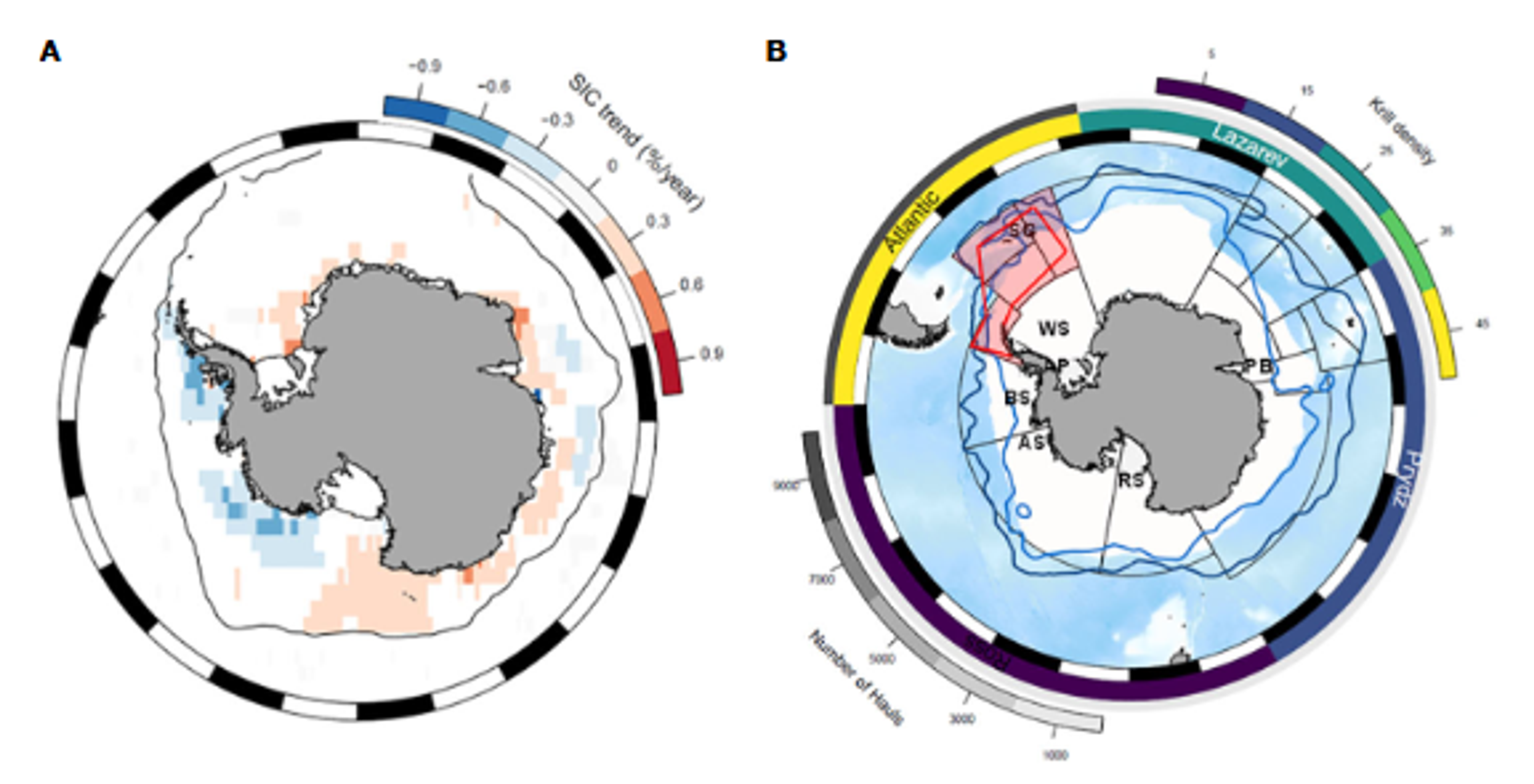
The figure shows sea ice changes and krill sampling patterns in the Southern Ocean. Panel A displays significant changes in sea ice concentration from 1978-2021, with red/orange areas showing ice loss and blue showing increases. The Antarctic Peninsula region shows dramatic ice decline. Panel B illustrates krill research effort (gray rings) and average krill density (colored rings) across different sectors. The Southwest Atlantic sector (pink) has received the most research attention and shows high krill densities, making it the primary focus for both scientific studies and commercial fishing. Key Findings
1
raditional research ship surveys are declining while new technologies (underwater platforms, robotic gliders, genetic analysis) operate over smaller geographic areas.2
Scientific debate continues over krill population trends in the Southwest Atlantic, with different conclusions depending on the sampling method, time period studied, and geographic coverage. 3
A workshop of 137 experts identified three critical solutions: better calibration between old and new methods, improved coordination of localized sampling programs, and expanded use of commercial fishing industry data.4
There is risk of both missing real population changes and incorrectly detecting false trends due to mismatches between sampling scales and the vast geographic range of krill populations.5
Current fishery management relies on outdated survey data from 2000. Experts recommend a fundamental shift towards a fishery management approach that prioritizes ongoing monitoring of stock status and can adapt to variability and change in krill populations.Abstract
Understanding and managing the response of marine ecosystems to human pressures including climate change requires reliable large-scale and multidecadal information on the state of key populations. These populations include the pelagic animals that support ecosystem services including carbon export and fisheries. The use of research vessels to collect information using scientific nets and acoustics is being replaced with technologies such as autonomous moorings, gliders, and meta-genetics. Paradoxically, these newer methods sample pelagic populations at ever-smaller spatial scales, and ecological change might go undetected in the time needed to build up large-scale, long time series. These global-scale issues are epitomised by Antarctic krill (Euphausia superba), which is concentrated in rapidly warming areas, exports substantial quantities of carbon and supports an expanding fishery, but opinion is divided on how resilient their stocks are to climatic change. Based on a workshop of 137 krill experts we identify the challenges of observing climate change impacts with shifting sampling methods and suggest three tractable solutions. These are to: improve overlap and calibration of new with traditional methods; improve communication to harmonise, link and scale up the capacity of new but localised sampling programs; and expand opportunities from other research platforms and data sources, including the fishing industry. Contrasting evidence for both change and stability in krill stocks illustrates how the risks of false negative and false positive diagnoses of change are related to the temporal and spatial scale of sampling. Given the uncertainty about how krill are responding to rapid warming we recommend a shift towards a fishery management approach that prioritises monitoring of stock status and can adapt to variability and change.Published in
Frontiers in Marine Science
2024Authors
Hill, S. L
Atkinson, A
Arata, J. A
Belcher, A
Bengtson Nash, S
Bernard, K. S
Cleary, A
Conroy, J. A
Driscoll, R
Fielding, S
Flores, H
Forcada, J
Halfter, S
Hinke, J. T
Hückstädt, L
Johnston, N. M
Kane, M
Kawaguchi, S
Krafft, B. A
Krüger, L
La, H. S
Liszka, C. M
Meyer, B
Murphy, E. J
Pakhomov, E. A
Perry, F
Piñones, A
Polito, M. J
Reid, K
Reiss, C
Rombola, E
Saunders, R. A
Schmidt, K
Sylvester, Z. T
Takahashi, A
Tarling, G. A
Trathan, P. N
Veytia, D
Watters, G. M
Xavier, J. C
Yang, G.
Institutions
British Antarctic Survey
Plymouth Marine Laboratory
Association of Responsible Krill Harvesting Companies
Forest Research
Griffith University
Oregon State University
Australian Antarctic Division
Virginia Institute of Marine Science
Alfred Wegener Institute
National Institute of Water and Atmospheric Research
Southwest Fisheries Science Centre
University of California Santa Cruz
University of Exeter
Mediterranean Institute for Advanced Studies
Institute of Marine Research
Instituto Antártico Chileno
Korea Polar Research Institute
Carl von Ossietzky University of Oldenburg
University of British Columbia
Marine Biological Association
Austral University of Chile
Louisiana State University
Ross Analytics
Instituto Antártico Argentino
University of Plymouth
University of Colorado Boulder
National Institute of Polar Research
University of Tasmania
University of Coimbra
Chinese Academy of Sciences
Methods
Data
Case
Acoustic
Field
Biological sampling
Read the full paper
Go to doi.org