Biomass
Fisheries management
Antarctic ecosystem
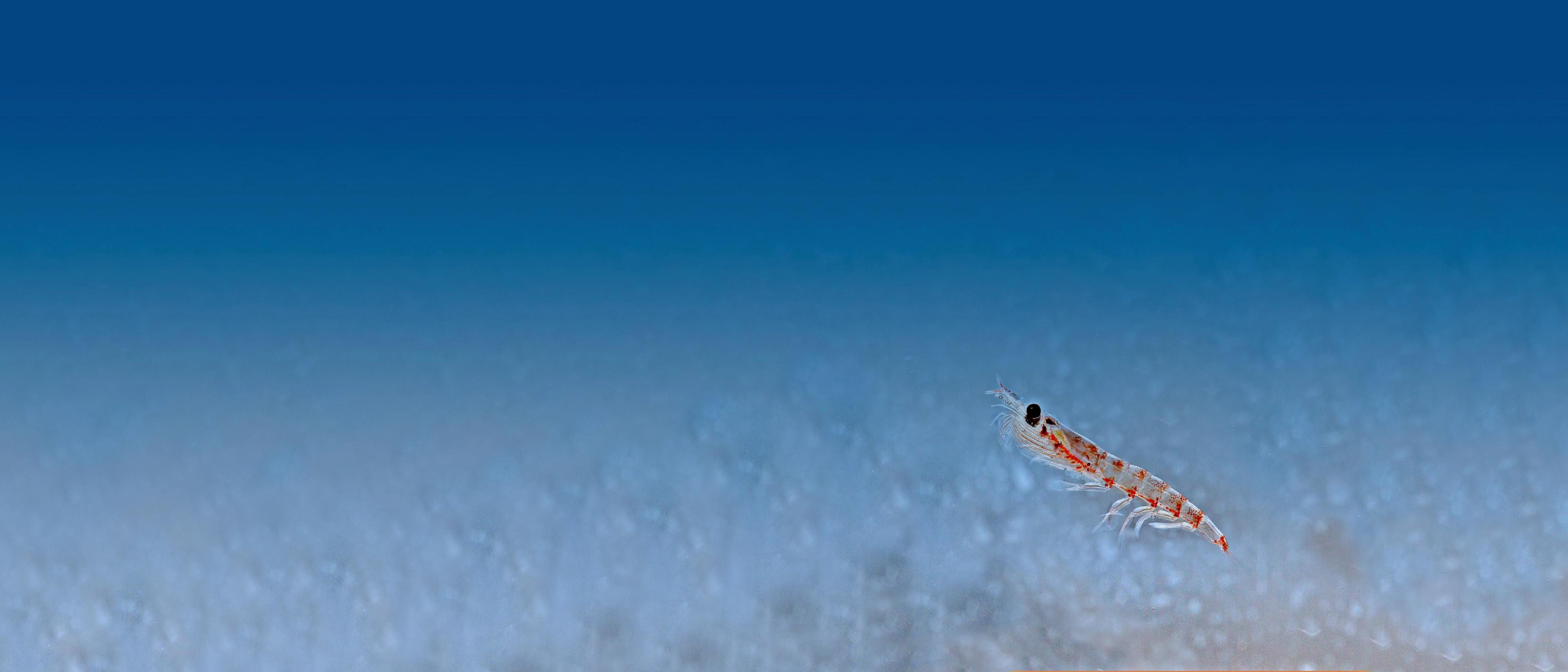
Krill (Euphausia superba)
Seasonal dynamics of an Antarctic krill resource hot spot in the Bransfield Strait, Antarctica
Summary
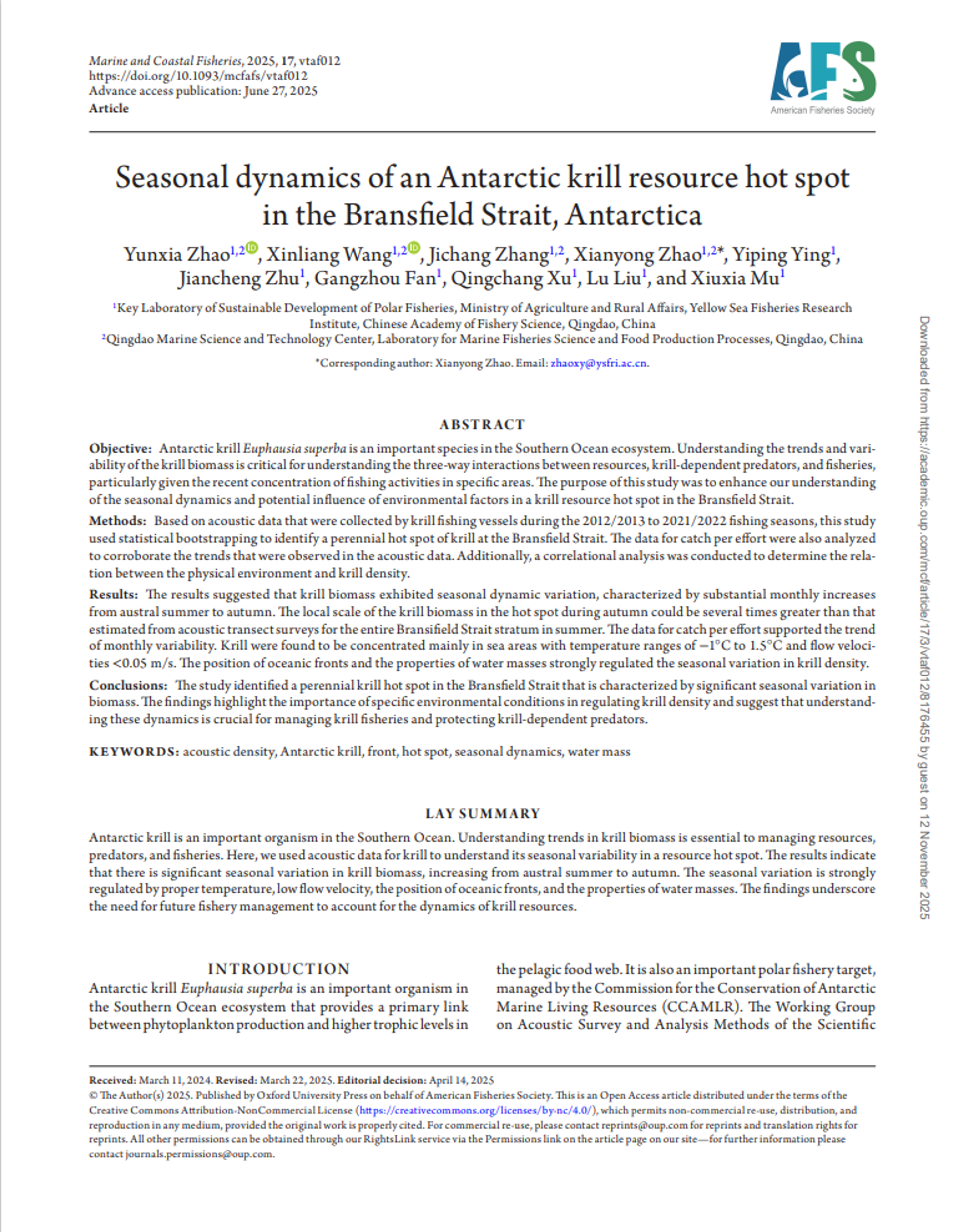
This decade-long study reveals a persistent krill hot spot in the Bransfield Strait where biomass increases dramatically from summer through autumn - contradicting assumptions that krill density remains stable throughout the fishing season. By analyzing acoustic data from Chinese fishing vessels operating during 2013-2022, researchers found that krill biomass in this relatively small hot spot during May can be 6 times higher than the entire Bransfield Strait's estimated summer biomass. The findings challenge conventional survey timing and highlight how seasonal ocean currents and water masses drive krill concentrations. Low-velocity zones where different water masses meet create ideal retention areas, while transport from the Bellingshausen and Weddell Seas continuously replenishes the population.
Key Findings
1
Krill biomass shows dramatic monthly increases from March through May, with May concentrations reaching 2,803±304 g/m² in the hot spot2
The hot spot's May biomass (up to 6.49×10⁹ kg in 2016) exceeded the entire Bransfield Strait's January survey estimate (1.04×10⁹ kg) by sixfold3
Krill concentrate in specific environmental conditions: water temperatures -1°C to 1.5°C and current velocities <0.05 m/s4
The Peninsula Front location and water mass properties (TWW vs TBW) strongly regulate seasonal krill density5
Low-velocity zones where different water masses converge act as retention areas, preventing krill from being swept away6
Commercial catch data (CPUE) corroborates acoustic findings, both peaking in May7
The hot spot receives krill through multiple depth layers via currents from both the Bellingshausen Sea (TBW/mCDW) and Weddell Sea (TWW)8
Findings suggest traditional summer surveys may significantly underestimate krill availability in fishing grounds during peak autumn seasonAbstract
This study examines seasonal dynamics and environmental drivers of krill concentration in a persistent hot spot within the Bransfield Strait using acoustic data from commercial fishing vessels (2012/2013 to 2021/2022 seasons). The research reveals dramatic seasonal variation in krill biomass, with substantial monthly increases from austral summer to autumn. The hot spot's autumn biomass can reach several times the entire Bransfield Strait's summer estimates. Krill concentrate in waters with temperatures between -1°C and 1.5°C and flow velocities below 0.05 m/s. The study demonstrates that oceanic fronts and water mass properties strongly regulate seasonal krill density variations, with transport from both the Bellingshausen Sea and Weddell Sea playing critical roles in maintaining high krill concentrations in this fishing ground.Published in
Marine and Coastal Fisheries, 2025, Vol. 17, No. 3
2025Authors
Yunxia Zhao
Xinliang Wang
Jichang Zhang
Xianyong Zhao
Yiping Ying
Jiancheng Zhu
Gangzhou Fan
Qingchang Xu
Lu Liu
Xiuxia Mu
Institutions
Key Laboratory of Sustainable Development of Polar Fisheries, Ministry of Agriculture and Rural Affairs, Yellow Sea Fisheries Research Institute, Chinese Academy of Fishery Science, Qingdao, China
Qingdao Marine Science and Technology Center, Laboratory for Marine Fisheries Science and Food Production Processes, Qingdao, China
Methods
Acoustic
Data
Read the full paper
Go to doi.org